
By Elizabet Cerqueira da Conceição
From MST’s Website
I tried to protect that specific tree, and this is my reward. This is the story of Sawyer Prempeh Samuel, a young recent graduate from Kwame Nkrumah University of Science and Technology, in Ghana. He was completing his mandatory national service at the Forestry Commission of Ghana, a requirement for every graduate of a tertiary institution in the country.
During his service, while fulfilling his duty to protect the country’s forest heritage, he and his team encountered illegal chainsaw operators. The confrontation turned violent. Sawyer suffered severe blows to the head and mouth. He was hospitalized, the case was reported to the police, the aggressors were arrested and released pending trial. Since September 2023, the case has been stalled. Justice does not move forward because some “leaders” interfere. Meanwhile, Sawyer lives with constant headaches and a life without justice.
He asks for help from those who hold environmental protection and sustainability in their hearts to mobilize in his defense and demand justice.
The story of Sawyer Prempeh Samuel is not an isolated case. It is the same State violence that kills workers when they defend the land not as a commodity, but as a means of life. It is the same system that turns those who protect the forest into victims, while those who destroy it go unpunished.
Oziel Alves – The Boldness of a Young Man Who Became a Seed

On the afternoon of April 17, 1996, at Curva do S, a stretch of the former PA-150, now BR-155, in Eldorado dos Carajás, Pará, the State Military Police massacred 21 landless workers. Among them was Oziel Alves Pereira, a young man of only 17 years old, executed at point-blank range with a shot to the forehead.
Oziel was not just a number among the dead. He was an activist, someone who carried the boldness of youth in the struggle for land. His life trajectory, marked by commitment to the cause of the landless, transformed his name into a symbol of resistance. Every year, when the MST commemorates the massacre at Curva do S, landless workers evoke the memory of Oziel Alves, highlighting his courage and his role in the struggle.
The violence at Curva do S was not an accident. It was a planned action by the State to defend the interests of large landowners. The landless were marching in demand for land, work, and dignity. The response was bullets. Oziel, at 17 years old, paid with his life the price of dreaming of a piece of land to plant and live.
But the seed that Oziel planted did not die. In 2003, the MST created the Pedagogical Camp of the Landless Youth Oziel Alves Pereira at Curva do S itself, transforming the site of the massacre into a space for political education. Every year, hundreds of landless youth gather there to study, organize, and strengthen the struggle. It is what they call “mística,” the art of transforming pain into resistance, memory into action.
This year, in 2026, marks 30 years since the massacre and 23 years of the camp. The National Brigade Oziel Alves continues to be launched at Curva do S, carrying the name of the young man who, at 17, was murdered for defending that the land belongs to those who work it.
The story of Oziel Alves is not only Brazilian. It is the same story of young people who, all over the world, are murdered for the “crime” of wanting land to live, not to profit. It is the same State violence that repeats its script: first criminalizes those who occupy, then kills, then tries to erase memory. But the memory of Oziel resists, sprouts, and blossoms like the trees we plant in his honor.
Amandla! Ngawethu! The Power is Ours!

In South Africa, the word “Amandla” means power in Zulu and Xhosa and echoed for decades as a battle cry against apartheid. It was not just a word; it was a call, a summons to resistance that united people in the streets, in prisons, in forced labor camps. When someone shouted “Amandla!”, the crowd responded in chorus: “Ngawethu!” meaning “It is ours!”
Music was the soul of this struggle. Songs of freedom were born in the townships, in churches, in prisons. Vuyisile Mini, composer and trade unionist, was hanged in 1964 by the racist regime. It is said that he went to his death singing, transforming his own execution into an act of resistance. Music comforted those who were imprisoned, motivated those on the front lines, and created a subterranean form of communication within prisons.
The toyi-toyi, a high-stepping dance, almost a war march, became a tool of struggle in the 1980s. It served to physically condition guerrilla fighters and intimidate the regime’s police. It was both dance and resistance at the same time. South African youth, such as Thandi Modise, imprisoned at 19 and who spent the latter half of the 1970s in prison, carried in their songs the memory of first love, the pain of separation, but also the determination to end apartheid.
The Marikana Massacre, in 2012, exposed to the world that State violence did not end with apartheid. Organized mining workers, while demanding dignity and fair wages, were brutally repressed by the South African police. 34 miners were murdered. It was the same system that expels, exploits, and kills, now with a new appearance, but with the same logic as always.
The struggle of Amandla continues. South African youth continue using music, dance, and the cry “Amandla! Ngawethu!” to resist persistent inequalities. The memory of those who fell fuels the resistance of those who remain standing.
By connecting Eldorado dos Carajás, Marikana, Amandla, and the ongoing struggles across the African continent, we affirm that these realities are deeply intertwined. It is the same system that expels, exploits, and violates, but it is also the same resistance that organizes, denounces, and builds alternatives.
Likewise, it is essential to highlight what has been happening in Ghana, where communities and movements have denounced the advance of deforestation, the destruction of territories, and the impacts of climate change directly linked to the predatory exploitation of natural resources. In this context, the struggle for land is also a struggle for environmental preservation, for the sovereignty of peoples, and for the continuity of life.
Internationalism, Global South Solidarity, and Self-Determination
Driven by La Via Campesina, this date brings together actions across different territories, connecting resistances and denouncing the multiple forms of dispossession affecting rural peoples.
We also seek to broaden the perspective on the African continent, bringing concrete elements of the struggle for land, which is often rendered invisible. Violence against workers is not an isolated fact; it manifests across all territories.
Therefore, the International Day of Peasant Struggles, celebrated on April 17, is not just a date of remembrance, it is a call for active solidarity among the peoples of the Global South.
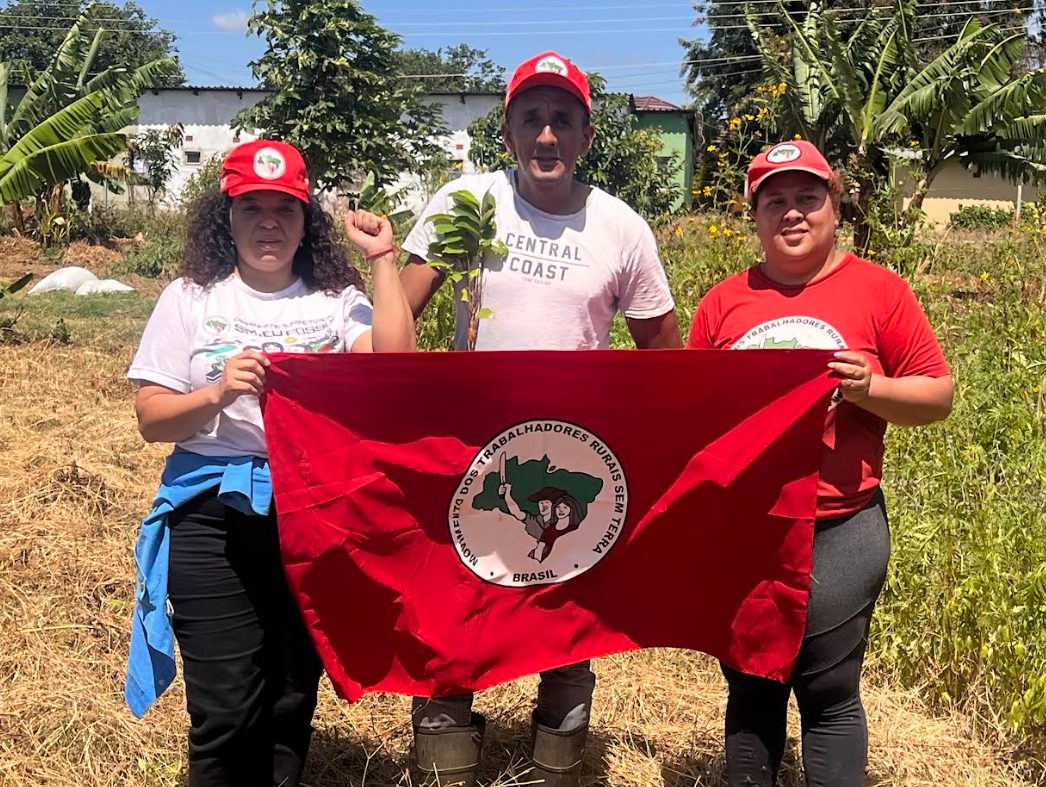
When we plant fruit trees in our Agroecological Experimentation Area in Zambia in memory of Oziel Alves, Marikana, and Sawyer Prempeh Samuel, we affirm that the struggle for land transcends borders and unites territories separated by colonialism, but connected by resistance. The internationalism of rural workers is the recognition that our pains are the same, our oppressors are the same, and our strength lies in the unity of our voices.
The self-determination of peoples is at the heart of this struggle. We do not accept that development models imposed from outside, whether State repression, Brazilian agribusiness, South African predatory mining, or logging exploitation in Ghana, define our destiny. Those who live on the land must decide their future. Land for those who live and work on it!
The planting we carry out in Zambia is, therefore, an act of sovereignty: we affirm our right to cultivate, preserve, and live in harmony with nature, rejecting the logic of profit that destroys forests, communities, and lives. The solidarity of the Global South is born from this shared refusal and from the collective construction of another possible world, where the land belongs to those who work it, and life is worth more than capital.
*Elizabet Cerqueira da Conceição is Coordinator of the Samora Machel Brigade in Zambia.
O post April 17, internationalized as the International Day of Peasant Struggles : A planting in memory of the global peasant struggle! apareceu primeiro em MST.


