
WITH THE PROMISE of reducing greenhouse gas emissions through the production of SAF (sustainable aviation fuel) and renewable diesel in Bahia’s Recôncavo region, Brazil, energy company Acelen attracted BRL 7 billion in public and private financing for the construction of a biorefinery in the area.
The funding was secured through a consortium led by HSBC and the IFC (International Finance Corporation, the World Bank’s investment arm), which includes ten other national and international financial institutions, among them BNDES and Bradesco.
Acelen expects to produce 1 billion liters of SAF annually starting in 2028. The company’s CEO, Luiz de Mendonça, says that 80% of the output has already been sold to markets in the United States and Europe.
With this projection, the initiative ranks among the main large-scale biofuel production projects for export identified by the federal government, according to EPE (Energy Research Company), an agency linked to Brazil’s Ministry of Mines and Energy. In 2025, President Luiz Inácio Lula da Silva attended the inauguration of one of Acelen’s macaúba project facilities in Montes Claros (Minas Gerais).
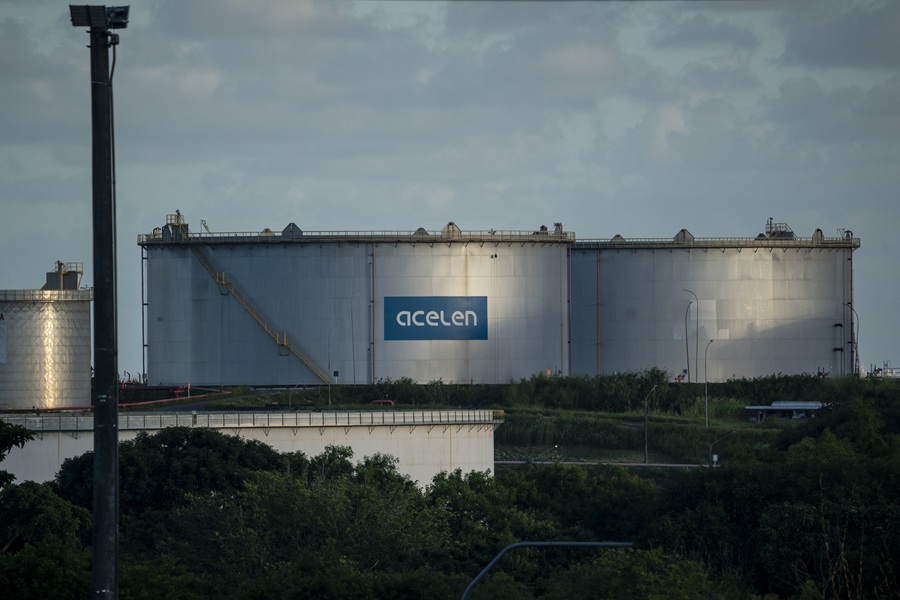
The macaúba palm will be processed at the biorefinery that the company plans to build in São Francisco do Conde (Bahia), on the shores of Todos os Santos Bay in the Recôncavo region. Acelen already operates an oil refinery in the area, which has a history of spills.
Complaints from Traditional Communities
Acelen already has macaúba plantations in the municipality of Cachoeira (Bahia), near the future plant. However, quilombola and shellfish-harvesting communities living close to the plantations complain about the installation of fences and signs restricting access to areas historically used by quilombolas for extractive activities and religious practices.
According to residents, these territories have been taken over by macaúba cultivation, and nearby roads—already marked by potholes—have deteriorated further due to the circulation of Acelen trucks and tractors since planting began in 2025.
The complaints led Brazil’s Federal Public Prosecutor’s Office (MPF) to open an investigation into whether the project violates the right of traditional communities affected by the future biorefinery and macaúba plantations to free, prior, and informed consultation, as guaranteed under ILO (International Labour Organization) Convention 169.
Contacted by Repórter Brasil, Acelen stated that the São Francisco do Conde biorefinery project “has been conducted through dialogue with potentially impacted communities.” The company also said that the process “involves free, prior, and informed consultation, as well as initiatives aimed at productive inclusion, professional training, and territorial development.”
Statements from the banks participating in the consortium
The IFC approved an investment of up to US$250 million (approximately BRL1.2 billion at current exchange rates) in the project. In response to questions from Repórter Brasil, the institution acknowledged that it had identified “social and environmental aspects requiring additional assessment and management to ensure alignment with the Performance Standards” and classified the project as presenting “high social and environmental risk.”
As a result, the IFC said it had required Acelen to implement specific measures, including impact assessments and the hiring of an independent environmental, health, and safety technical adviser. Read the full response here.
Contacted by Repórter Brasil, HSBC declined to comment.
The other international banks participating in the consortium are FAB (First Abu Dhabi Bank), ADCB (Abu Dhabi Commercial Bank), IDB Invest, AIIB (Asian Infrastructure Investment Bank), FinDev Canada (Development Finance Institute Canada), KfW IPEX-Bank, BBVA, and Bank of China.
In a statement to Repórter Brasil, IDB Invest, the private-sector arm of the Inter-American Development Bank, said that its loan is “limited to the development of the new biorefinery,” a project subject to “rigorous due diligence and supervision,” and that the existing oil refinery and the macaúba plantations “are not part of the scope of the financing.”
Germany’s KfW IPEX-Bank also stated that its financing is restricted to the biorefinery in São Francisco do Conde and that Acelen’s macaúba cultivation project was not included in its 2025 environmental and social assessment.
Spain’s BBVA said it considers that Acelen has implemented adequate measures to address the environmental and social issues related to the project.
Development bank FinDev Canada told Repórter Brasil that it hired an independent social and environmental consultant and conducts ongoing supervision aligned with international standards and carried out “in close coordination with the other co-financiers,” in addition to periodic site visits whenever deemed appropriate.
FAB, ADCB, AIIB, and Bank of China had not responded by the time this report was published. The full statements from all financial institutions contacted by the reporting team can be read here.
Support from BNDES
In Brazil, the consortium’s financing partners are BNDES and Bradesco.
Acelen secured R$503 million from BNDES (Brazilian Development Bank) to build the biorefinery in Todos os Santos Bay. The project also received R$258 million from the Brazilian development bank for Agripark, Acelen’s technology park in Montes Claros (Minas Gerais), dedicated to research, development, and the structuring of the macaúba supply chain.
Asked by Repórter Brasil, BNDES said it does not finance Acelen’s macaúba cultivation and that its financial feasibility analyses and assessments of social and environmental risks are limited to the scope of the projects it finances. Regarding the biorefinery, it said it had “verified compliance of the operation with applicable legal and regulatory requirements, including environmental licensing and its conditions.”
“We reiterate that it is the company’s contractual obligation to remain compliant with environmental authorities throughout the entire financing period,” the bank stated.
Bradesco did not respond to requests for comment before publication. The full statements from all financial institutions contacted by the reporting team can be read here.
Acelen was also included in Eco Invest Brasil, a National Treasury program aimed at financing low-carbon and energy-transition projects. Through the mechanism, the company was authorized to raise R$4 billion for its macaúba initiative. This is the largest amount allocated to projects supported by the program in 2025.
According to the program’s monitoring platform, HSBC is among the private financiers linked to Eco Invest Brasil for Acelen’s macaúba project.
Asked by Repórter Brasil, the National Treasury said that under the program’s structure, the risk assessment and financing approval decisions are the responsibility of the participating financial institution, which is required to provide accountability until all resources are fully repaid. In Acelen’s case, the responsible bank is HSBC.
According to the Treasury, activities financed by the program may not “be involved, directly or indirectly, in significant environmental or social harm” or other rights violations. “Based on the information brought forward by Repórter Brasil, the National Treasury will take the appropriate steps to notify the responsible bank so that the facts reported to date may be properly clarified,” the statement said. Read the full response here.
Banks may be ‘violating’ impact assessment guidelines
“Banks know very well that the main impacts of a biorefinery are in the plantations, not in the refinery itself. IFC Performance Standard 1 clearly states that ‘the process of identifying risks and impacts will also consider risks and impacts associated with primary supply chains,’ with emphasis on labor rights and environmental impacts,” says Merel van der Mark, coordinator of the Forests and Finance coalition.
Van der Mark also cites the Equator Principles, which guide the assessment of social and environmental impacts throughout a project’s area of influence. “The OECD (Organisation for Economic Co-operation and Development) recommends that financial institutions identify and assess high-risk issues within the supply chain. By failing to assess the chain of custody, banks may be violating these guidelines, as well as their own policies and commitments,” she says.
Leia também
The post HSBC and IFC lead BRL 7 Billion investment in ‘green’ plant criticized by quilombola communities appeared first on Repórter Brasil.


